
The core technical value is reflected in three dimensions: first, specific and precise recognition, relying on specific antibodies to achieve precise binding with target antigens while avoiding non-specific interference; second, efficient signal amplification, capturing trace protein expression signals through enzymatic reactions and polymer amplification systems to improve detection sensitivity; third, standardized and reproducible results, with all reagent formulations and reaction conditions fixed and validated, significantly reducing human operational errors and ensuring consistency of experimental results across different batches and scenarios, meeting the rigor of clinical diagnosis and the traceability requirements of scientific research experiments.
Buffer and Retrieval System:Includes PBS buffer and sodium citrate antigen retrieval solution. PBS buffer is used for section washing, reagent dilution, and maintaining acid-base balance of the reaction system to ensure stable antigen-antibody binding environment; sodium citrate retrieval solution is used for high-temperature high-pressure retrieval to reverse antigen cross-linking and masking caused by formalin fixation and paraffin embedding, fully exposing antigen sites and improving staining positive rates.
Blocking and Quenching System:Composed of endogenous peroxidase blocking reagent and normal serum blocking solution. Endogenous peroxidase blocking reagent can efficiently quench naturally occurring peroxidase activity in tissue samples, completely eliminating non-specific staining background caused by endogenous enzymes; serum blocking solution can block tissue blank protein binding sites, reducing non-specific antibody adsorption, with dual effects lowering experimental background noise and ensuring staining specificity.
Immune Binding and Signal Amplification System (HRP Enzyme-Labeled Secondary Antibody System):As the core functional module, includes primary antibody diluent and HRP enzyme-labeled universal rabbit/mouse secondary antibody. This system is compatible with mainstream rabbit-derived and mouse-derived primary antibodies, working on the principle of direct enzyme-labeled secondary antibody amplification, achieving efficient signal amplification through enzyme molecule-catalyzed chromogenic reactions, which is the core mechanism of basic IHC kits for target protein-specific recognition and stable color development.
Chromogenic and Termination System:Features DAB chromogenic solution as the core, paired with chromogenic diluent. Under HRP enzyme catalysis, it generates stable brown insoluble precipitate, precisely marking target protein expression locations. The chromogenic product has strong stability, supporting long-term section preservation and retrospective observation.
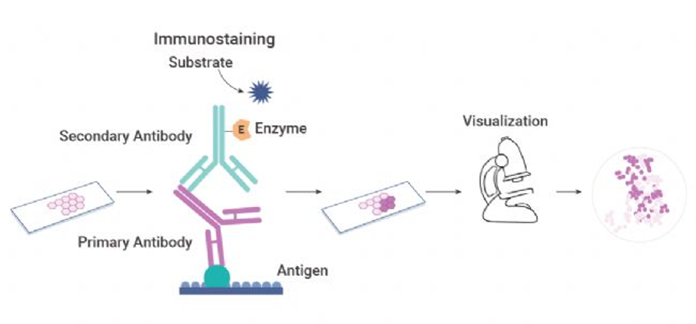
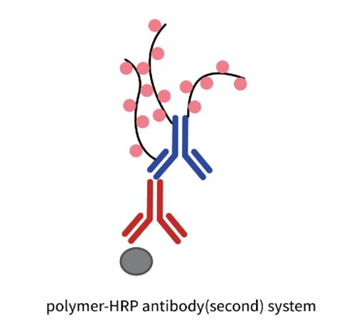
This product continues the core advantages of the basic HRP system, with mature technology, broad compatibility, and outstanding cost-effectiveness, perfectly suited for medium-to-high abundance protein detection, large-scale sample screening, and scientific research pre-experiments. The system is stable with minimal batch-to-batch variation, making it an economical kit of choice for basic life science research and routine target validation, fully meeting conventional IHC qualitative and semi-quantitative detection needs.
Compared with the basic kit, this product has four core product advantages: first, ultra-high detection sensitivity, with signal amplification efficiency far exceeding conventional HRP systems, capable of precisely recognizing low-abundance, micro-expressed difficult targets, effectively avoiding false negative results; second, excellent tissue permeability, with flexible polymer structure significantly reducing spatial penetration steric hindrance, efficiently penetrating dense tumor tissues, fibrotic tissues, and other complex samples, with uniform and thorough staining, free from superficial staining and uneven staining issues; third, extremely low background interference, with strong anti-interference color capability, perfectly suited for liver, kidney, endocrine, and other high-background difficult tissues; fourth, efficient and stable experimentation, with streamlined workflow, low human error, and high result reproducibility.